The marketing narrative for 2025/2026 is seductive: models offer context windows of 1 million to 10 million tokens. The implication is that you can simply “paste your entire codebase” into the prompt and the AI will reason perfectly across it.
The Reality
This is operationally false and financially dangerous. Current research identifies a phenomenon known as Context Rot: Large Language Models (LLMs) do not process information uniformly. A model’s ability to reason degrades as the input length grows, meaning the 10,000th token is treated with significantly less fidelity than the 100th.
“Naive” long-context usage, dumping all files into the window, burns tokens at a massive rate while degrading output quality. Agents tend to prioritize Recall (grabbing every file that might be relevant) over Precision, introducing vast amounts of “noise” that actively confuses the model. You are essentially paying more to make your AI dumber.
Cascading Failures in Multi-Step Reasoning Agents attempting to solve problems through multi-turn conversations (reasoning depth) are highly vulnerable. Context Rot causes early, minor errors to propagate and compound—a phenomenon known as “Agentic Cascading.”
The Lower Seniority Accountability Gap
Before looking at the machines, we must look at the humans. As AI tools lower the barrier to entry for coding, many organizations are leaning heavily on lower seniority talent to drive development.
The risk is clear: lower seniority engineers often lack the accountability and deep architectural experience required to evaluate the code an AI generates. When an AI produces a functional-looking snippet that actually introduces subtle security flaws or architectural “blue” (technical debt), a lower seniority developer may not see the warning signs. Without the correct project structure and the “atomization” of components, AI doesn’t just accelerate work; it accelerates the accumulation of unmanageable complexity.
The “Brownfield” Problem
Most business codebases are “Brownfield” environments: a chaotic mix of legacy human code and newer AI boilerplate. Human developers rely on implicit knowledge, while AI agents rely on explicit matching.
When your codebase is a monolith with vague naming conventions, AI agents suffer from an Information-Architecture Gap. They might find the buggy file but fail to fix it because the surrounding 100,000 lines of irrelevant code create a “utilization gap.”
The Strategic Solution: Architectural Isolation
Since you cannot “prompt” your way out of Context Rot, the only performant strategy is a human one: Architectural Isolation.
The future of AI-accelerated development isn’t about building “smarter” agents that can read 10 million lines of code. It is about human architects refactoring systems so that an agent—and the junior developers using them—never need to see more than 10 files to solve a problem.
Root cause: What is Context Rot?
Context Rot describes the phenomenon where a Large Language Model’s (LLM) performance degrades significantly and unpredictably as the length of its input (context) increases. While modern models boast “million-token” windows, they do not process this information uniformly.
The assumption that a model handles the 10,000th token with the same fidelity as the 100th is false. As the context grows, the model’s ability to reason, retrieve, and follow instructions deteriorates, leading to a state where the “usable capacity” of the model is far lower than its nominal context window.
Key characteristics of Context Rot include:
1.Non-Uniform Processing: Performance drops are not linear. Models may handle short contexts perfectly but fail to retrieve information or follow instructions once the input crosses a certain threshold (e.g., 20k tokens), even if the “answer” is present in the text.
2.Sensitivity to “Distractors”: Rot is often triggered by “distractors”, irrelevant content that is semantically similar to the target information. As context length grows, the model becomes increasingly unable to distinguish between the correct data (the needle) and these distractors, leading to hallucinations.
3.The “Needle” Fallacy: Models often score highly on simple “Needle in a Haystack” (NIAH) benchmarks, which test finding a specific keyword (lexical retrieval). However, Context Rot becomes severe in real-world tasks that require semantic understanding (connecting logic across disconnected files) or identifying the absence of information.
Context Range (Tokens) | Reasoning Accuracy (%) | Attention Retention (%) | Effective Recall (%) |
0 – 8,000 | 92.5 | 98.4 | 99.1 |
8,001 – 32,000 | 78.4 | 82.1 | 85.3 |
32,001 – 64,000 | 62.1 | 65.4 | 70.2 |
64,001 – 128,000 | 44.3 | 41.2 | 48.6 |
128,001 – 256,000 | 28.7 | 22.5 | 31.4 |
The “Deep” vs. “Wide” Problem
Experiments show that models are actually more robust to a single noisy context (“width”) than to noisy iterative reasoning (“depth”). Enforcing multiple reasoning rounds often lowers performance because the model reinforces its own hallucinations.
The Mechanism: An agent might retrieve a slightly irrelevant file in Step 1. Because the context is “rotting” (filled with noise), the model treats this distractor as fact in Step 2. By Step 3, the agent has deviated entirely from the original query.
Some LLMs tend to expand retrieved contexts aggressively to achieve higher recall, while introducing excessive irrelevant content that results in lower precision. For example, GPT-5 achieves higher recall at both the block and line levels but sacrifices precision, leading to lower overall F1 and, consequently, reduced issue resolution performance compared to Claude Sonnet 4.5.
Feature | Deep (Agentic) | Wide (Long Context) |
Strategy | Break task into small, iterative steps. | Load all data at once; solve in one pass. |
The Problem | Cascading Errors: One bad query poisons the entire future chain. | Context Rot: Precision degrades; model “hallucinates” details in the middle. |
Failure Mode | The agent confidently answers the wrong question (Drift). | The agent generates invalid code/facts despite having the right files (Noise). |
Business Risk | High latency and cost (many steps); risk of “rabbit holes.” | High cost (input tokens); illusion of capability (model sees data but can’t use it). |
The challenge of Context Rot is exponentially compounded when AI agents must reason over human-generated codebases
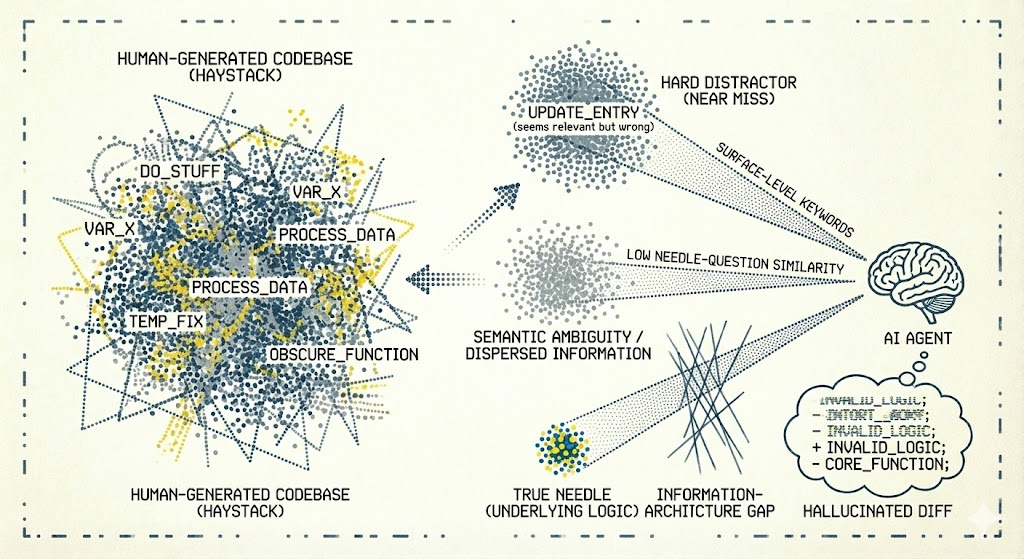
The human generated codebase is characterized by vague variable naming and ambiguous function definitions; in this case, the AI must infer relevance without exact lexical matches, a scenario typical of poorly named functions where the semantic link is obscure.
In these environments, agents attempting to perform file localization often suffer from an “Information-Architecture Gap,” where they rely on surface-level keywords that fail to map to the underlying logic, leading to the retrieval of “hard distractors” or “near misses” that look semantically relevant but are functionally incorrect.
The Illusion of Control
There is a prevailing belief among engineering leaders that if an agent fails, the solution is better instructions: more detailed system prompts, stricter output schemas, or more complex “skills” (custom tools). However, recent empirical data suggests this is largely an illusion of control.
Developers are over-indexing on “Agent Scaffolding” (skills, prompts, tools) while under-estimating the catastrophic impact of “Context Rot” in large, messy codebases.
You can define specific “skills” for your agent, but you cannot program its reasoning. Research shows that models like GPT-5 and Claude Sonnet 4.5 struggle to adhere to complex retrieval protocols, often favoring “recall” (grabbing everything) over “precision” regardless of the constraints you place on them. In many cases, agents essentially ignore the scaffolding, the developer controls the environment, but the model controls the attention, and in long contexts, that attention drifts unpredictably.
The theoretical promise of AI agents assumes a clean, well-documented codebase. The reality is a “Brownfield” environment: a chaotic mix of legacy human code (often with vague variable names) and newer, AI-generated boilerplate. This mixture creates a hostile environment for Large Language Models (LLMs) due to Semantic Ambiguity.
Human developers rely on implicit knowledge (“utils.py handles the dates”). Agents rely on explicit lexical matching. When codebases contain vague terms, typical in human code, agents suffer from an “Information-Architecture Gap”. For example, in a Django issue, an agent failed because it searched for surface-level keywords like “db_table” but missed the relevant validation logic hidden in a file named model_checks.py because the semantic link was abstract, not literal
Hard Distractors occur when an agent encounters code that is semantically similar but technically irrelevant to the bug. Standard dense retrievers struggle to filter these “near misses,” often flooding the context window with misleading data. This “poisons” the agent’s reasoning, causing it to hallucinate edits, reference non-existent functions, or target the wrong line numbers.
The context window is not a bucket; it is a filter, and in large monolithic projects, it’s a filter that quickly becomes overwhelmed.
As more of the monolith’s code is fed into the model, its performance doesn’t just level off, it crashes, a stark manifestation of the “Needle in a Haystack” problem. This leads to a critical “Utilization Gap,” where the agent successfully locates the buggy file but fails to use it when generating a fix because the surrounding 100,000+ tokens of irrelevant code drown out the signal.
The paradox is that increasing the number of retrieved files to find the right code also introduces substantial noise, degrading the model’s F1 score and effectively costing more in compute to confuse the model with more data. Ultimately, the bottleneck is not a lack of tools, but the fact that current LLM architectures physically lose reasoning fidelity when submerged in the noise of a large-scale codebase, a problem that no amount of prompt engineering can fix.
The Only Real Fix: Architectural Isolation
Since we cannot “prompt” our way out of Context Rot, the only performant strategy is a human one: Architectural Isolation. Reducing the amount of content the AI agent is required to look at is the single most effective way to increase performance. This is not an AI problem; it is a software architecture problem.
The Partitioning Strategy: To enable agents to work on large systems, we must break monolithic projects into highly focused, isolated functionalities with minimal dependencies. Research confirms that domain-partitioned schemas allow agents to navigate up to 10,000 tables with high accuracy, whereas dumping the same amount of data into a single context fails. By isolating dependencies, we artificially create the “short context” environment where LLMs thrive.
The future of AI-accelerated development isn’t about building smarter agents that can read 10 million lines of code. It is about human architects refactoring systems so that an agent never needs to read more than 10 files to solve a problem.
The most effective architectural intervention for scaling agents to massive systems is the implementation of “Domain-Partitioned Schemas”. Rather than forcing an agent to navigate a single, monolithic schema or codebase, the system is broken down into semantic layers that the agent can read through native file operations.
Experimental data shows that “file-native” agents using domain-partitioned schemas can maintain high navigation accuracy even in environments with 10,000 tables. This approach bypasses the “Context Rot” cliff by keeping the agent’s active context window focused and small, while externalizing the system’s global complexity into the file system.
Aggressive Compaction and Contextual Retrieval Strategies
For agents operating in a continuous loop, the only way to combat “Context Rot” is through aggressive, structural compaction of the context. This involves a departure from the “chat history” model where all messages are retained. Instead, effective agent harnesses must actively prune their context: if the agent reads a file, the harness should retain the file’s path and a compact summary but drop the raw contents once the edit is complete.
Furthermore, Anthropic’s research into “Contextual Retrieval” suggests that adding 50-100 tokens of high-precision, chunk-specific metadata can reduce retrieval failures by nearly 50%. This is a form of architectural isolation at the “chunk” level: by embedding each piece of code with its own architectural context (e.g., “This function belongs to the validation module and depends on the database constraint logic”), the retriever can ensure that the agent receives only the most relevant “gold context” and nothing else.
Conclusion: The Architecture is the Lever
The technical bottleneck in agentic software engineering is not a lack of reasoning power, but the catastrophic impact of “Context Rot” and the “Information-Architecture Gap” in large, messy codebases. Developers who over-index on “Agent Scaffolding”, prompts, tools, and orchestration, are essentially adding noise to a system that is already struggling with signal clarity.
The evidence from ContextBench and other process-oriented evaluations is clear: sophisticated scaffolding yields marginal returns, while architectural isolation provides the only reliable path to scaling performance. To move beyond the current plateau, the industry must embrace a data-centric approach to agentic systems, where the “Control” is exerted not through the agent’s loop, but through the radical isolation and bottlenecking of the information the agent is allowed to see. In the coming era of automated software engineering, the codebase itself becomes the most critical piece of scaffolding and its architectural clarity, or lack thereof, will determine the ultimate success of the agentic revolution.