Would you like to see all of your AI initiatives, their workflows, and their tools under one fully auditable and traceable view? Every AI initiative in your organisation, the workflows your domain experts build, the coding and reasoning agents your engineers rely on, the external systems each one touches, can live under a single view instead of scattered across teams and tools where no one can account for them. AscentCore AI Hub brings them together as one governed portfolio, where every run writes itself to a durable, append-only history, every scheduled pipeline executes a published, versioned playbook, and every decision, output, and model call is recorded in a trail you can inspect, export, and defend.
“A faster individual is not a faster organisation, the gain evaporates the moment it meets the next desk that still works by hand.”
Every organisation now has private evidence that AI works. An engineer ships a feature in an afternoon that used to take two days. An analyst cleans a dataset before the coffee cools. A support agent closes tickets at a pace that would have earned a bonus a year ago. The evidence is real, and the research agrees with the anecdote. In three randomised field experiments spanning 4,867 software developers at Microsoft, Accenture, and an anonymous Fortune 100 firm, access to an AI coding assistant raised the number of completed tasks by roughly 26 per cent, with the largest gains going to less experienced staff. In a separate study of 5,179 customer support agents, generative assistance lifted issues resolved per hour by 15 per cent on average, and by 35 per cent for the least experienced workers.
The productivity is scattered across individuals, invisible in aggregate, and unaccounted for in any system of record. A firm can be measurably faster at the level of the person and completely flat at the level of the profit and loss statement. This is the first uncomfortable fact about AI economics: individual acceleration does not sum to organisational productivity. It has to be engineered to, and most organisations have not done the engineering.
Where the Economics Actually Turn
Organisational productivity obeys a different equation than individual productivity. It improves when the total human effort required to run a process falls, not when the effort per task falls for one person. Those sound similar and are not. Shaving a task from sixty minutes to forty is a personal win. Removing a human from the loop of ten thousand such tasks is a structural one.
The turn happens when three conditions hold at once:
- The work has to arrive in large batches, because the volume is what makes automation cheaper than salary.
- The work has to chain across teams, because the expensive delays in most organisations live in the handoffs, the invoice that waits for finance to notice it, the ticket that sits until someone triages it, the report nobody assembles until Friday.
- A human has to remain in command of the exceptions, because a process that cannot escalate its own edge cases is not automated, it is merely unsupervised.
This is where the first wave of enterprise AI stalled. It was a tools story, and tools are bought by individuals for individual tasks. The second wave is an orchestration story, and orchestration is a capability owned by the organisation. Building that capability is the work AscentCore set out to do with two connected products: a workflow platform where the individual keeps precise control over how deterministic and probabilistic steps combine, and an orchestrator that brings every tool in the estate under a single roof.
One Roof for Deterministic and Probabilistic Work
The instinct when people hear “AI automation” is to imagine handing the whole process to a model and hoping. That is exactly the arrangement that produces the result at scale, unbounded probabilism with the steering tax pushed onto whoever has to clean up afterwards. Serious automation does the opposite. It confines the probabilistic parts to where judgement genuinely adds value and keeps everything else deterministic, repeatable, and provable.
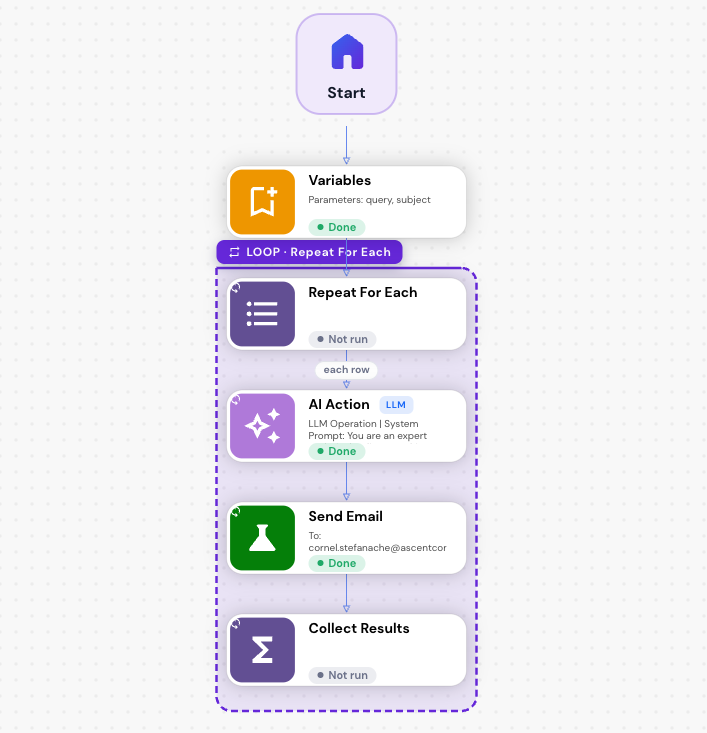
To solve that problem we’ve built AscentCore Insights on that discipline. A domain expert, not an engineer, breaks a manual process into steps and lays each step out as a block on a visual canvas. The blocks connect into a directed acyclic graph, and data flows through the pipeline deterministically, so the same inputs produce the same outputs every time. Into that deterministic spine the builder places probabilistic steps precisely where they earn their keep: an AI steps to classify a document, to summarise a contract, to decide whether an exception is material. The person building the workflow decides the exact mix. They choose where the process must be exact and where it may reason, and they can see, read, and audit that choice because it is written in plain steps rather than buried in a model’s behaviour.
The economics are wired in at the same level. Insights routes each step to the appropriate model rather than sending everything to the most expensive one, and in practice 60 to 85 per cent of steps run on local open-source models at zero inference cost, with frontier models reserved for the genuinely hard reasoning. Cost stops being a function of how enthusiastically the organisation uses AI and becomes a function of how well the work is routed. That is the difference between an AI bill that scales with adoption and one that scales with value. The whole platform deploys inside the client’s own perimeter, credentials scoped per user in a vault and revoked automatically, every execution written to an immutable log, which is what makes it usable in finance, compliance, and operations rather than only in experiments.
The Orchestrator
Insights automates a process. The harder problem is the organisation, dozens of processes across finance, HR, engineering, and operations, each valuable alone and disconnected from the rest. That is the problem AscentCore AI Hub exists to solve. It is the control tower that brings every tool, deterministic and probabilistic, under a single roof and lets them run as one coordinated capability.
Think of it in three layers. At the bottom are the workers, the things that actually do the work: the business workflows built in Insights, the leading AI coding and reasoning agents your engineers already rely on, and the outside systems the company runs on. In the middle are the playbooks, the Orchestrations that direct those workers. At the top is the command view, a single organisational map of everything that exists and everything that is running. The genius of the arrangement is that no layer needs to understand the one below it in technical terms. A person writes a playbook in plain language, and AI Hub is responsible for turning each written step into the right worker doing the right thing.
The unit of work is the Orchestration, a playbook written as a numbered list of plain-English steps. A finance lead might write: pull the open invoices, check each against its contract, flag the exceptions, proceed only if the exception rate is under two per cent, write a summary, and send it to the controller. AI Hub reads that list, interprets the intent of each step, selects the capability that satisfies it, runs it, and passes the output of one step into the next as the input it needs. Anyone who can write a checklist can build one, and because the logic is written in language rather than buried in code or in a model’s behaviour, nothing in the pipeline is a black box. Every step can be read, reviewed, and defended.
What makes an Orchestration powerful is the range of work a single one can chain together. The steps are not all of one kind; a pipeline can move fluidly between deterministic execution, probabilistic reasoning, external action, and human judgement in whatever order the process actually demands.
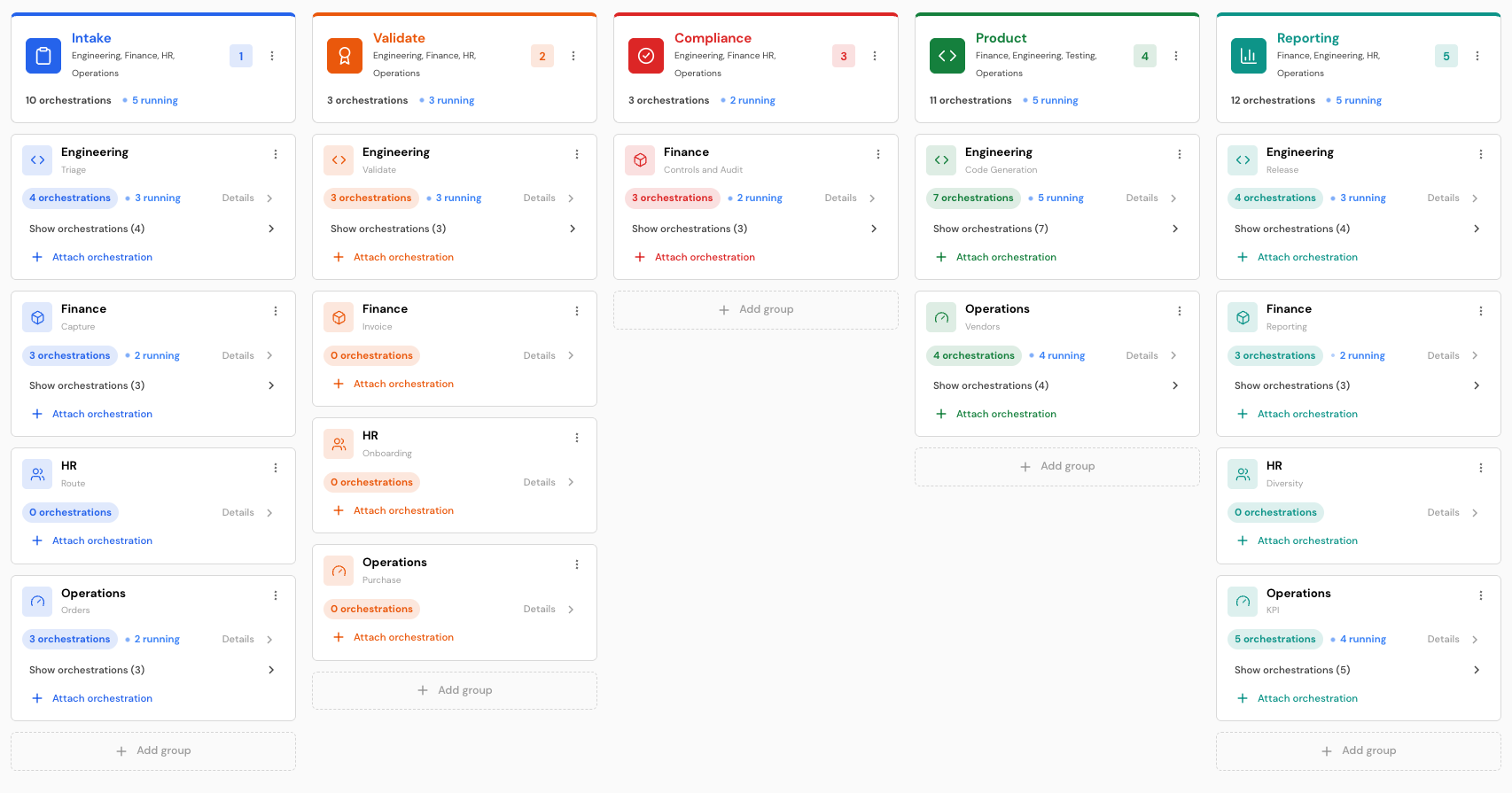
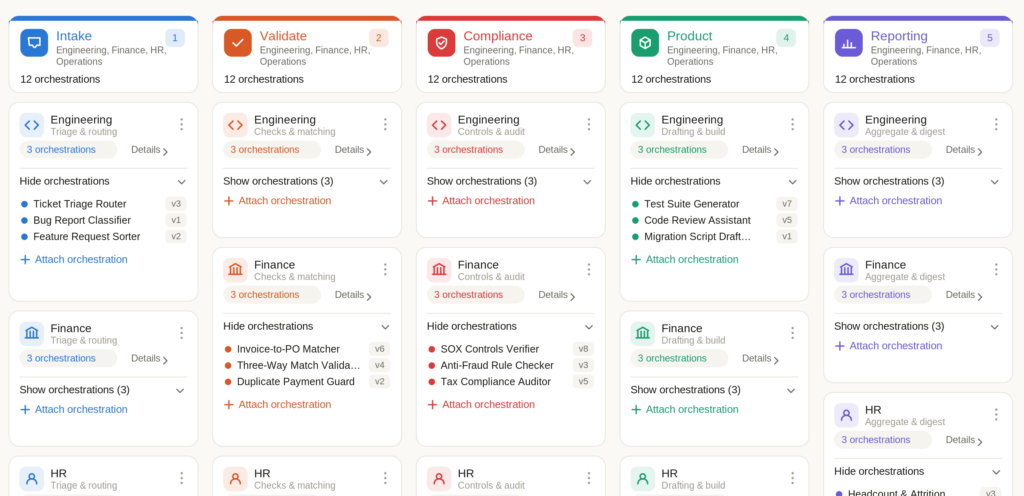
Sitting above all of it is the command view, an Orchestration Overview that arranges every automation by the process loop it serves and the business group it belongs to. It is the answer to the question leadership has never been able to answer with evidence: what is our AI actually doing right now? From one screen a leader sees every automation that exists, which are live and which are paused, how often each runs and how it is performing, and which parts of the business are automated and where the gaps still are. The map is organisation-wide by design, so everyone works from the same picture, while only administrators can reshape the structure itself.
Trust is engineered into the layer beneath all of this. Every run is written to a durable, append-only log of each step, decision, and output, a history that survives disconnects, restarts, and staff turnover, and that follows the automation rather than the person, so a shared process stays auditable by the whole responsible group and does not vanish when an individual leaves. Access is role-based, view-only or edit, granted per playbook. Each user’s connections to company systems are scoped to them, held in a secure vault, and revoked automatically when the work that needed them completes, so credentials are never left lying around. Like Insights, AI Hub is built to run inside your own perimeter, and like Insights it draws on both local and frontier models so cost stays controlled as autonomy scales, the cheap, repetitive reasoning kept on local models and the expensive frontier calls reserved for the steps that genuinely need them. A proven automation can be captured once and safely re-run by others, spreading the value without spreading the access.
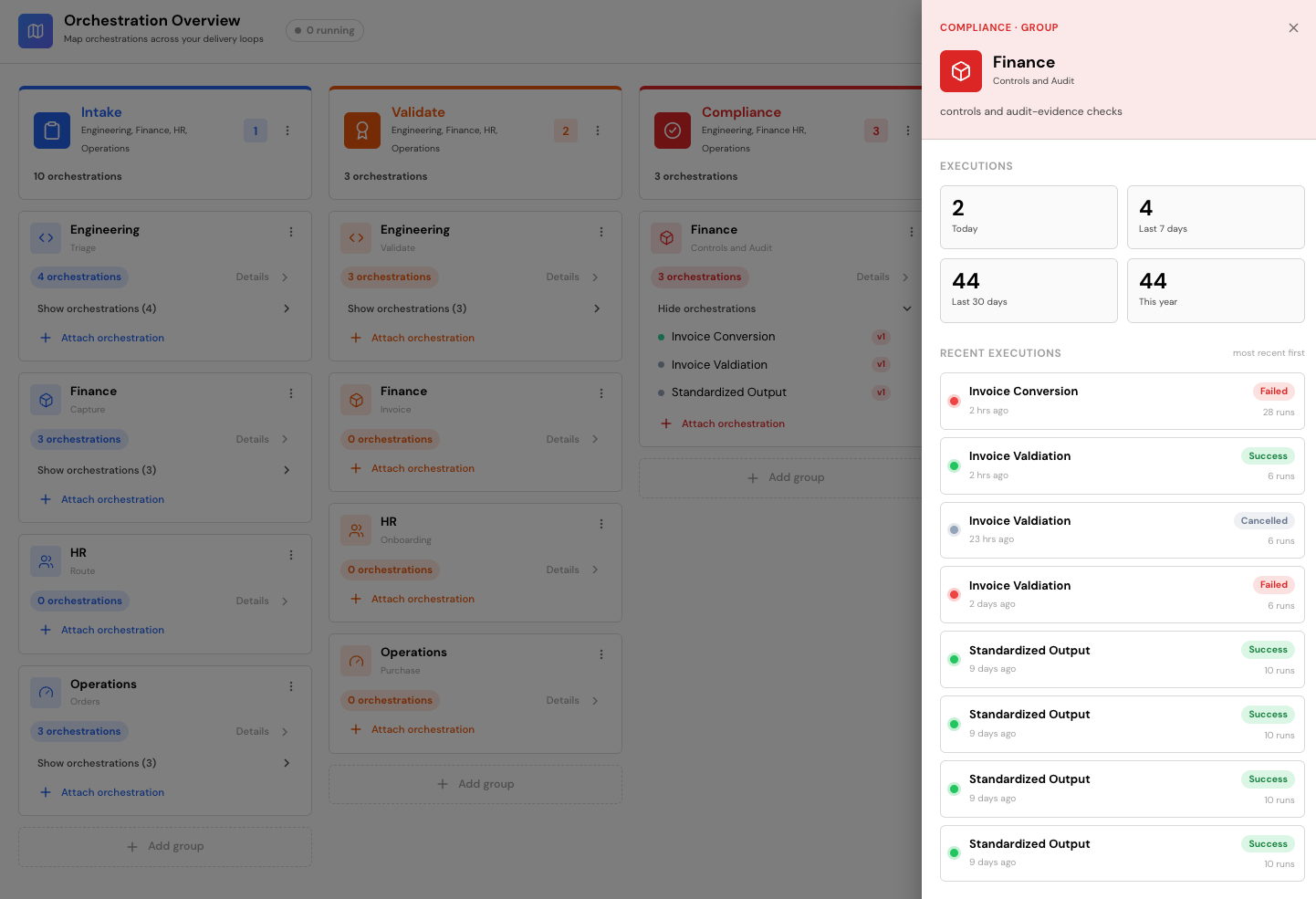
Every run in AI Hub writes itself into a permanent, append-only history, a step-by-step record of what the automation did, which model or system it called, what it decided at each gate, and what it produced, captured as it happens so nothing depends on anyone remembering to log it. That history follows the automation rather than the person, so a shared process stays fully auditable by the whole responsible group and survives disconnects, restarts, and staff turnover. Because scheduled and shared Orchestrations always execute a published, versioned copy of the playbook, there is a durable record of who published which version and when, and point-in-time snapshots let you inspect or roll back to the exact logic that ran on any given day. When a regulator, a client, or your own board asks to see precisely what the AI did, what it decided, and why, the answer is not scattered across personal machines and chat logs, it is a complete, tamper-evident, exportable trail that is a few clicks away. Auditability stops being the tax you pay for adopting AI and becomes the reason you can defend expanding it.
The Human Who Stays in Command
There is a version of this future that reads as displacement, the machine taking the work. The evidence points somewhere more interesting. The tasks that automate cleanly are the ones people rarely wanted, the reconciliation, the triage, the assembling of the same report every week. What resists automation is judgement under ambiguity, the material exception, the call that carries financial or regulatory or human weight. An orchestration platform that surfaces exactly those decisions to exactly the people equipped to make them is not removing humans from work. It is removing them from the parts of work that never needed them and concentrating them on the parts that always did.
That is the quiet reversal underneath the economics. For a decade the promise of software was that it would let each person do more. The promise of orchestrated agentic AI is different and larger: that a small number of skilled people can hold command over a volume of work that no headcount plan could ever have staffed, not because they are doing more, but because they are deciding more and doing less.