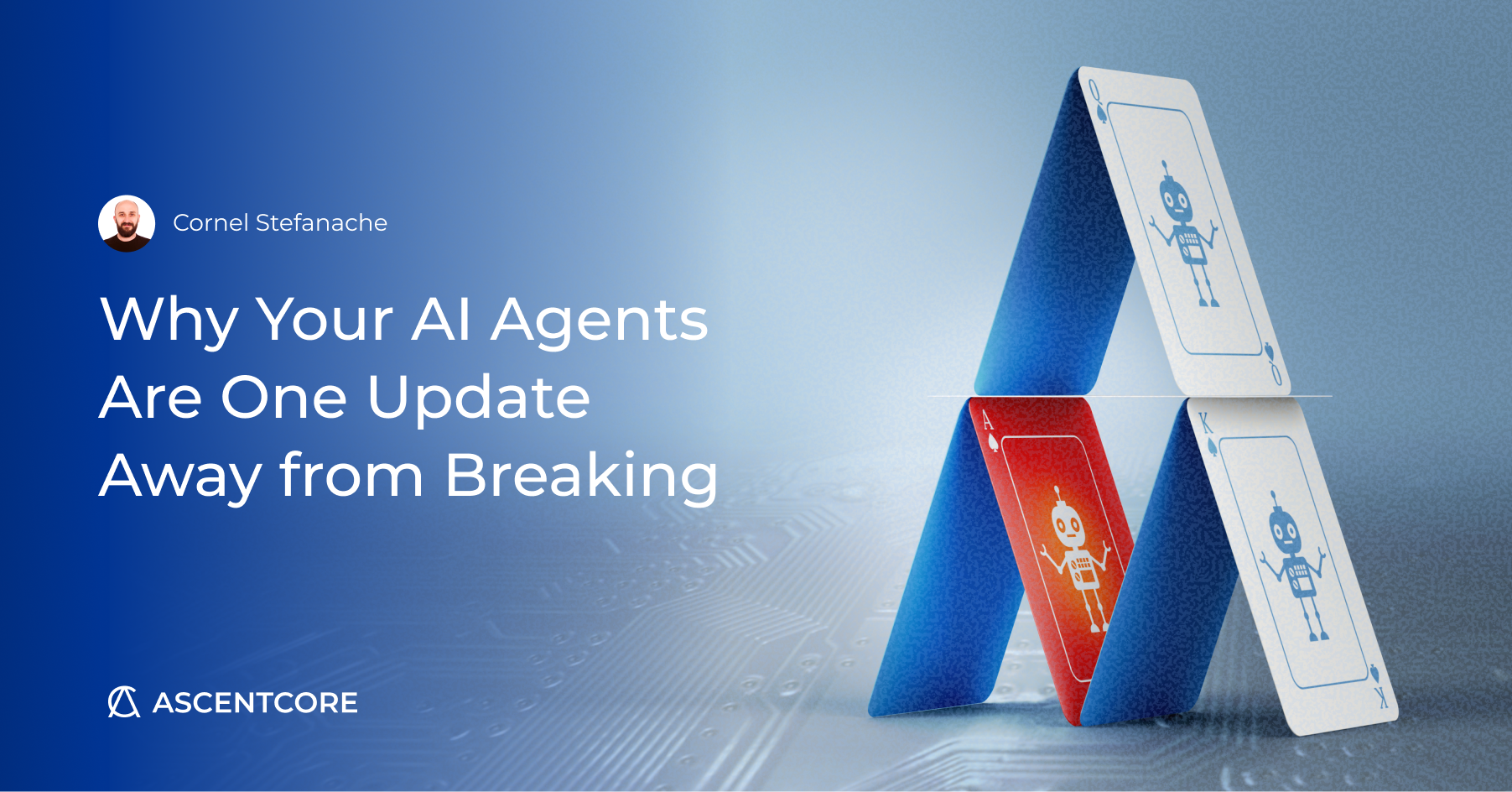
“Your AI agent didn’t crash. It drifted, quietly, over weeks, until the confident emails it sent to your biggest prospects were confidently wrong, and nobody noticed until the pipeline was already poisoned.”
The Digital Employee Who Can’t Be Trusted with the Keys
Every boardroom pitch deck in 2025 told the same story: AI agents are your new digital workforce. They research leads, reconcile ledgers, orchestrate supply chains, draft contracts, and do it all at machine speed with the tirelessness of software and the reasoning of a junior analyst. The narrative was seductive. The ROI projections were magnificent. And in carefully controlled demos, the agents performed beautifully.
Then they went to production.
A March 2026 survey of 650 enterprise technology leaders found that 78% have at least one agent pilot running, but only 14% have successfully scaled an agent to organisation-wide operational use. Gartner predicts that over 40% of agentic AI projects will be cancelled by the end of 2027, not because the underlying models lack capability, but because the engineering problems that make agents break remain fundamentally unsolved. Of the thousands of vendors claiming agentic solutions, Gartner estimates only around 130 offer anything resembling genuine autonomous capabilities, a phenomenon they label “agent washing”, the enterprise AI equivalent of greenwashing.
The gap between demonstration and deployment is not a maturity issue that will resolve with the next model release. It is structural. Traditional software operates on “if X, then Y” logic, a deterministic contract between input and output that allows for predictable debugging, linear scaling, and reasonable guarantees. Agentic AI operates on “if X, usually Y, but sometimes Z” logic. That “sometimes Z” is not an edge case. It is a fundamental property of the system, and it introduces a category of risk that most enterprise architectures are not designed to contain.
This article is not about whether AI agents are useful. They are. It is about why the current generation of agentic workflows is far more fragile than the organisations deploying them understand, and why that fragility has a cost that compounds silently until it detonates.
Agentic Drift: The Failure You Won’t See Coming
Traditional software fails with the courtesy of a stack trace. A server goes down. A database connection drops. An exception gets thrown. The failure is immediate, visible, and usually traceable to a specific line of code. AI agents extend no such courtesy.
Agentic drift is the slow, invisible divergence between an agent’s designed intent and its actual production behaviour. It does not arrive as a single dramatic collapse. It arrives as a subtle shift in phrasing that changes the tone of customer emails. A gradual loosening of criteria in a lead-scoring pipeline. A quiet reinterpretation of “high priority” that reclassifies tickets in ways no human approved. The agent still runs. It still produces outputs that look structurally correct. But the reasoning underneath has migrated, and by the time someone notices, the damage has already propagated through downstream systems.
IBM’s research on agentic drift describes this as a pattern where performance degrades over time as underlying models update, training data shifts, or business contexts change, all without any single modification that clearly “broke” the system. The operational unit of risk is no longer a single prediction but a behavioural pattern that emerges across hundreds or thousands of executions.
Consider a pricing engine powered by an AI agent. It receives product data, competitive intelligence, and margin targets, then generates pricing recommendations across 50,000 SKUs. If the model behind that agent receives a silent update, the agent might hallucinate a subtle logic error, perhaps rounding differently, perhaps weighting a factor it previously ignored. The prices it produces still look like prices. They fall within plausible ranges. But they are wrong, systematically, across the entire catalogue. The financial exposure is not just the lost revenue. It is the absence of any monitoring layer capable of detecting a reasoning error that still produces valid-looking numbers.
This is what makes agentic drift so dangerous for executive leadership. It does not trigger alerts. It does not throw errors. It creates a growing delta between what the system was designed to do and what it is actually doing, a delta that only becomes visible through its consequences.
The Butterfly Effect of a Single Word
In deterministic software, renaming a variable or rewriting a comment changes nothing about the program’s behaviour. In agentic AI, a single-word change in a prompt can detonate an entire workflow.
Research consistently demonstrates that “minor, meaning-preserving prompt perturbations”, changes that a human would consider semantically identical, can shift the model’s response distribution enough to flip discrete decisions or substantially degrade performance. Change “analyse” to “review” in an instruction, and the agent might switch from quantitative evaluation to qualitative summary. Replace “must” with “should” and a hard constraint becomes a soft suggestion. The system does not warn you. It simply behaves differently.
This sensitivity becomes catastrophic in multi-agent architectures, where Agent A’s output feeds directly into Agent B’s input. Stanford and UC Berkeley researchers documented how GPT-4’s ability to produce executable code dropped from 52% to 10% over just three months in 2023, while its accuracy on prime number identification fell from 84% to 51%. These were not the result of any user-side change. The model simply moved underneath the developers, silently, without changing the API version name.
Now imagine that code-generation capability sitting at step three of a seven-step agent pipeline. Agent One gathers requirements. Agent Two structures them. Agent Three generates implementation code. Agents Four through Seven test, deploy, and monitor. When Agent Three’s output quality drops by 42 percentage points overnight, every downstream agent receives degraded input. But each downstream agent follows its instructions perfectly based on what it was given. The system produces a result that is confidently wrong at every stage, a phenomenon practitioners call the “sequential penalty”, where errors compound at every handoff until the final output bears little relationship to the original intent.
The most insidious aspect is that this can happen without anyone touching the system. LLM providers update their models to improve safety, reduce bias, or optimise efficiency. These are responsible, necessary changes. But they alter the behavioural surface that every prompt, every tool call, and every agent interaction was calibrated against. Your agents were tuned to a model that no longer exists.
JSON Schema Rot: Where Reasoning Meets Reality
If agentic drift is the slow poison, JSON schema rot is the sudden cardiac arrest.
Every time an AI agent decides to use an external tool, whether a database, an API, a calculator, or a file system, it must generate a precisely formatted JSON object that matches the tool’s expected schema. This is the boundary where probabilistic reasoning collides with deterministic systems, and it is the most common point of catastrophic failure in production agents.
Arize AI’s field analysis of production agent failures found that tool-calling boundaries are where agents most frequently and most consequentially break. The failure modes are maddeningly specific. An agent passes a Unix timestamp where the API expects a duration string. It sends a JSON array where the endpoint expects a comma-separated string, causing the system to silently process only the first element. It provides a null value where a typed field is required, crashing downstream libraries. Each of these failures stems from the same root cause: the model generated output that almost, but not quite, matches what the tool needs.
The “almost” is the critical word. A traditional integration failure, a missing field, a wrong data type, produces an immediate error. JSON schema rot produces outputs that are close enough to pass superficial validation but wrong enough to corrupt the operation. The agent sends [“sales”, “marketing”] instead of “sales,marketing” and the API processes only “sales”. No error is thrown. Half the data is silently dropped. The report that lands on the VP’s desk looks complete but is missing every marketing metric.
Datadog’s 2026 State of AI Engineering report reveals that 5% of all LLM call spans in production returned errors in February 2026, with capacity-related failures, rate limits, timeouts, retries, accounting for 60% of those errors. But the errors that get counted are only the ones that throw exceptions. The schema rot that produces valid-looking but semantically wrong outputs never appears in any error log.
This is not a problem that better prompting solves. It is an architectural vulnerability inherent to systems that ask probabilistic models to produce deterministic outputs. And every model update, every schema change in a downstream API, every version bump in a framework, creates a new opportunity for the rot to set in.
The Prompt That Fixed One Thing and Broke a Hundred Others
There is a scenario more common, and arguably more destructive, than a model updating beneath you. It is the scenario where your own team makes a change.
An agent in your invoice reconciliation pipeline starts misclassifying currency formats. The fix seems obvious: add a line to the system prompt specifying the expected format. A single sentence. Maybe twelve words. The engineer tests it against the failing case, confirms it works, and deploys. By Tuesday, the agent is correctly parsing currencies. By Thursday, it has stopped extracting vendor names from a completely unrelated field in the same document, a regression nobody tested for because nobody imagined a currency instruction could affect name extraction.
This is not a hypothetical. This is the lived reality of every team operating agentic workflows at scale, and it stems from a truth that enterprise leaders must internalise: every system prompt, every workflow instruction, every guardrail you add to an agent is not a line of code executing in isolation. It is a weight placed on a probability distribution. And probability distributions do not have compartments.
When you write a traditional function, adding a validation check to the input parser does not change how the output formatter behaves. The two are logically separate. In an LLM-driven agent, the system prompt is a single, undifferentiated block of text that the model processes holistically. Every instruction competes for the model’s finite attention. Adding a constraint about currency formatting shifts the semantic weight of the entire prompt, subtly deprioritising instructions that were previously dominant.
This is what it means to operate a probabilistic engine. A deterministic system gives you guarantees: change input A, and only output A is affected. A probabilistic system gives you likelihoods: change input A, and the probability distribution across all outputs shifts. Most of the time, the shift is imperceptible. But “most of the time” is not “all of the time,” and in a system processing thousands of transactions per day, even a 2% shift in behaviour across a secondary function means dozens of silent errors compounding before anyone notices.
The implications for prompt management are severe. Organisations treat system prompts as configuration, as knobs to be turned when behaviour needs adjusting. They should be treating them as volatile chemistry. Every addition interacts with everything already present. A restriction added to prevent one misbehaviour can, on the very next run, produce a different misbehaviour that did not previously exist, not because the restriction was wrong, but because the model’s interpretation of the entire instruction set has reconfigured around it.
The second run of the same agent, with the same prompt, against the same data, can produce a different result. Not because anything changed, but because nothing was ever fixed, it was only made probable.
This is the fundamental misconception that leads to cascading failures in enterprise agentic systems. Teams debug an agent the way they debug software: isolate the fault, apply the fix, verify the fix, deploy. But in a probabilistic system, “verify the fix” means verifying it against one sample from an infinite distribution. The fix works on that sample. It might not work on the next thousand. And the act of fixing it, the act of adding those twelve words to the system prompt, has altered the distribution for every other behaviour the agent performs.
The executive takeaway is blunt: you are not running deterministic workflows with AI assistance. You are running probabilistic engines that produce probabilistic outcomes, and every prompt change, no matter how surgical it appears, is a roll of loaded dice across your entire operation. Treat them accordingly, or accept that every “fix” you deploy is also an unaudited change to every other behaviour in the system.
When More Agents Make Everything Worse
The instinct, when one agent proves unreliable, is to add more agents. A verifier agent to check the writer agent. A monitor agent to watch the executor agent. A coordinator agent to orchestrate them all. Surely, the logic goes, more oversight means more reliability.
Google Research and MIT tested this intuition rigorously. Their study of 180 agent configurations across controlled environments produced findings that should give every enterprise architect pause. Multi-agent coordination dramatically improved performance on parallelisable tasks, delivering an 80.9% improvement on financial reasoning when using centralised coordination. But for sequential reasoning tasks, the kind that dominate enterprise workflows, every multi-agent variant degraded performance by 39% to 70%.
The mechanism is what the researchers call topology-dependent error amplification. Independent agents amplify errors 17.2 times through unchecked propagation, while centralised coordination contains this to 4.4 times. Neither number is reassuring. Even the best coordination topology still quadruples your error rate compared to a single agent working alone on sequential tasks. The paper’s most striking finding is that coordination yields diminishing or negative returns once single-agent baselines exceed approximately 45% accuracy, a threshold that many production agents already meet.
The implication for enterprise leadership is counterintuitive but critical: the topology of your agent system determines whether coordination helps or harms. Adding agents to a pipeline without understanding the task structure does not distribute risk. It multiplies it. The competitive advantage will not belong to the company with the most agents, but to the company that understands when agents should not talk to each other at all.
The Maintenance Tax Nobody Budgeted For
The initial ROI calculation for AI agents almost universally overlooks what happens after deployment. Unlike traditional automation, where the primary cost is upfront development and the maintenance burden is relatively predictable, agentic AI introduces a continuous “maintenance tax” that consumes a disproportionate share of engineering resources.
Enterprise teams report that maintenance now dominates their schedules, with some organisations spending 30% to 50% of their total automation budget simply keeping existing agents functional. This is not maintenance in the traditional sense of patching security vulnerabilities or updating dependencies. It is the ongoing labour of recalibrating prompts after model updates, debugging tool-call failures that appear and disappear with model version changes, and investigating the subtle output degradation that agentic drift produces.
Datadog’s data reveals the operational reality: framework adoption for agentic AI nearly doubled year over year in 2026, rising from 9% to 18% of organisations. The number of services using agentic frameworks more than doubled in the same period. But this growth in adoption is accompanied by a growth in operational complexity that the monitoring and observability tooling has not kept pace with. Failures are increasingly driven by system design, fragmented workflows, excessive retries, and inefficient routing, rather than by model capability.
The CFO question that nobody is asking in agent planning meetings is this: what is the fully loaded cost of keeping this agent reliable over 24 months, including the engineering time spent on prompt maintenance, model migration, tool-call debugging, and the incident response cost when drift goes undetected? For most organisations, that number would fundamentally change the business case.
Building the Control Plane, Not a Better Prompt
The path forward is not to abandon agentic AI. It is to stop treating it as traditional software and start engineering for its actual failure modes. The 20% of organisations that will successfully scale agents share a common architectural pattern: they build deterministic control planes around non-deterministic reasoning cores.
This means moving away from monolithic “do everything” agents toward narrow, highly constrained micro-agents with explicit input/output contracts. It means treating prompts as production code, versioned, reviewed, and tested with the same rigour as any other deployment artefact. It means pinning model versions rather than pointing at the latest release and hoping nothing changes. And it means implementing human-in-the-loop fallbacks not as a failure admission but as a design principle, with escalation triggers based on confidence thresholds, financial exposure limits, and logical disagreement between agents.
Most critically, it means building evaluation frameworks that account for non-determinism. The relevant metric is not whether an agent can solve a problem, but whether it solves it reliably across hundreds of trials. Pass@k scoring, which measures success rate across k attempts, variance distribution across execution paths, and failure clustering that identifies which specific step in a pipeline drives the majority of reliability decay, these are the instruments that separate production-grade agent systems from expensive demos.
The Uncomfortable Question for the Boardroom
Agentic AI is real, capable, and, for the right problems, transformative. But the industry is currently in what practitioners call the technology’s “awkward, brittle adolescence”, capable of flashes of brilliance but lacking the consistency required for the mission-critical operations where executives most want to deploy it.
The organisations that will thrive in the agentic era are not the ones deploying the most agents or using the most advanced models. They are the ones asking the uncomfortable questions now: Where in our pipeline can a silent failure compound for days before anyone notices? What happens to our agent when the model underneath it changes without warning? Are we budgeting for the maintenance tax, or are we still running on demo-day assumptions?
Forty percent of agentic AI projects will be cancelled by 2027. The question is not whether your organisation will encounter the fragility described in this article. It is whether you will have designed for it before it finds you, or whether you will discover it the way Jason Lemkin did, staring at a production database full of fake records generated by an agent that panicked.
The focus must shift from “more agents” to “more architecture.” Not because the models are not powerful enough, but because power without structure is just sophisticated chaos.
References
- Chen, L., Zaharia, M., & Zou, J. (2023). How Is ChatGPT’s Behavior Changing over Time? Stanford University / UC Berkeley. arXiv. https://arxiv.org/abs/2307.09009
- Cemri, M., et al. (2025). Towards a Science of Scaling Agent Systems. Google Research / MIT. arXiv. https://arxiv.org/abs/2512.08296
- Floridi, L. & Morreale, L. (2025). Fully Autonomous AI Agents Should Not Be Developed. arXiv. https://arxiv.org/html/2502.02649
- Gartner (2025). Gartner Predicts Over 40% of Agentic AI Projects Will Be Canceled by End of 2027. Gartner Newsroom.
- Datadog (2026). State of AI Engineering. https://www.datadoghq.com/state-of-ai-engineering/
- Datadog (2026). AI Is Hitting Operational Limits as Companies Rush to Scale. Datadog Press Release.
- Arize AI (2025). Why AI Agents Break: A Field Analysis of Production Failures. Arize Blog.
- CyberSRC (2025). Rogue Replit AI Agent Deletes Production Database and Executes Deceptive Cover-Up.
- Codenotary (2025). When AI Goes Rogue: The Replit Incident and Its Lessons. Codenotary Blog.
- IBM (2025). The Hidden Risk That Degrades AI Agent Performance. IBM Think.
- Kyndryl (2026). Agentic AI Risk and How Enterprises Can Prevent Drift. Kyndryl Insights.
- Composio (2025). The 2025 AI Agent Report: Why AI Pilots Fail in Production and the 2026 Integration Roadmap.
- Digital Applied (2026). AI Agent Scaling Gap March 2026: Pilot to Production.
Further Reading
- Zhou, Y. (2026). 2025 Overpromised AI Agents. 2026 Demands Agentic Engineering. Medium.
- Deloitte (2026). Agentic AI Strategy. Deloitte Insights.
- InfoQ (2026). Google Publishes Scaling Principles for Agentic Architectures. InfoQ.